
Rafael Hayes · 3 November 2026
Balancing Accessibility and Security in Scaling Specialized Virtual Hubs
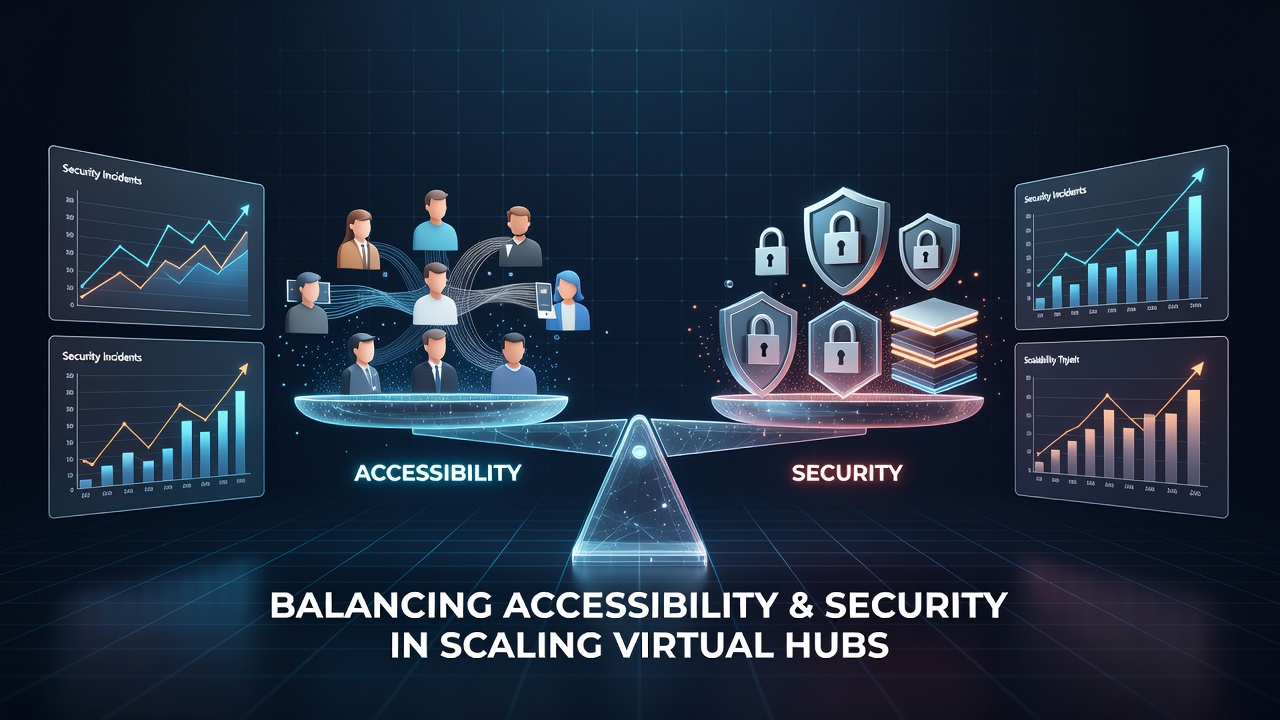
Specialized virtual hubs operate as focused digital environments that connect particular user groups through tailored tools and resources, and these platforms encounter distinct pressures when user bases expand rapidly. Growth introduces demands for broader entry points that accommodate diverse participants while preserving controls that limit unauthorized exposure of sensitive data and functions. Observers note that organizations managing such hubs often track metrics on login success rates alongside incident reports to gauge how well these elements coexist during scaling phases.
Core Tensions During Expansion
Accessibility features such as single-sign-on integrations, mobile-optimized interfaces, and multi-language support expand participation, yet each addition creates potential entry vectors that security protocols must address through encryption standards, role-based permissions, and continuous monitoring systems. Research from government agencies shows that platforms scaling beyond several thousand active users typically experience a measurable rise in access-related queries, which prompts administrators to layer verification steps without creating bottlenecks that discourage legitimate use. Data indicates that the number of authentication layers correlates directly with retention figures in many documented cases.
Security measures scale through automated threat detection, regular audit cycles, and segmented network architectures, and these elements work alongside accessibility provisions when implemented with clear mapping between user roles and permitted actions. Experts have observed that without coordinated planning, one domain advances at the expense of the other, producing either overly restrictive environments or gaps that become evident once traffic volumes increase.
Practical Approaches in Growing Platforms
Teams responsible for virtual hubs frequently adopt modular permission frameworks that allow administrators to grant granular access based on verified credentials and activity patterns. These frameworks support accessibility by enabling quick onboarding while embedding security checkpoints that activate only when risk signals appear. According to guidelines published by the National Institute of Standards and Technology, adaptive authentication methods reduce friction for returning users and maintain higher security postures during periods of rapid membership growth.
Another technique involves embedding accessibility testing into security review cycles so that interface changes undergo evaluation for both usability and vulnerability exposure. This combined review process helps teams identify conflicts early, such as when a new collaboration feature inadvertently broadens data visibility beyond intended boundaries. Figures from industry reports reveal that platforms conducting joint reviews report fewer post-deployment adjustments compared with those handling the areas separately.
Evidence from Recent Scaling Events
One documented instance involved a specialized research collaboration hub that doubled its membership between 2024 and 2025. Administrators introduced progressive profile verification alongside simplified dashboard navigation, and subsequent analysis showed stable session durations with a decline in unauthorized access attempts. The approach relied on predefined role templates that expanded automatically as new user categories joined, preserving consistency across access rules.
Similar patterns appear in educational virtual environments where institutions added external partners during curriculum updates. Security teams deployed time-limited tokens for guest accounts while keeping core resources behind persistent multi-factor requirements, and the combination supported wider participation without elevating overall risk scores tracked by monitoring tools. Such examples illustrate how targeted adjustments address the dual requirements when growth accelerates.
Looking Toward November 2026
By November 2026, several regulatory bodies across different regions are expected to release updated frameworks addressing digital platform governance, and these documents will likely emphasize measurable standards for both accessibility compliance and security certification. Platforms preparing for those expectations now focus on logging systems that capture accessibility usage data and security events in unified reports, enabling clearer responses to future oversight requirements. Canadian and Australian cybersecurity centers have already signaled interest in cross-border alignment on these metrics, which may influence how specialized hubs document their scaling practices.
Conclusion
Specialized virtual hubs that scale successfully maintain explicit mappings between accessibility enhancements and corresponding security controls, allowing both dimensions to advance without mutual interference. Data from multiple sources demonstrates that coordinated implementation, regular joint testing, and role-based permission systems contribute to sustained platform stability as participation grows. Observers continue to monitor how emerging standards in late 2026 will shape ongoing adjustments in these environments.